


Introduction
Production digital printing delivers many advantages such as on-demand printing, 1:1 personalization, and just-in-time manufacturing. One of the lesser-promoted advantages has been, for a certain subset of devices, the ability to add colors or special effects beyond the process colors of cyan, magenta, yellow, and black (CMYK). These digital embellishment effects, sometimes called CMYK+ or print enhancements, present an intriguing opportunity to mimic traditional print and finishing effects or to create entirely new ones. A recent study from Taktiful and WhatTheyThink presents some new data on this exciting opportunity.
What Are Digital Embellishments?
The ability to print more than just the process colors (cyan, magenta, yellow, and black) is a common feature of offset presses, which often have a fifth or sixth unit for printing special effects like Pantone colors, metallic inks, and neon or fluorescent colors. CMYK+ is also common in wide format digital printing, with many devices supporting eight or twelve colors. Yet in the production digital print market for documents, four-color devices are the most common, with a relatively small number of exceptions.
Systems supporting more than four colors (what is frequently referred to as CMYK plus or CMYK+) have been around since as early as the 1990s in devices from HP Indigo, Kodak NexPress, and Xeikon. In the past decade or so, CMYK+ capabilities expanded to a much wider range of digital print devices, which most frequently offer a fifth color for effects like clear coatings, white, and special colors. These extra colors/effects, which may also be called print enhancements, are applied in-line with CMYK. In addition, there is also a class of offline devices that use digital print techniques to add special effects like spot coatings, dimensional effects, and metallic foils.
Findings from the Taktiful/WhatTheyThink Study
Following up on a study of specialty digital ink and toner embellishments that Taktiful and WhatTheyThink conducted in 2023, the 2025 print embellishment study aimed to dig deeper into how print service providers (PSPs) are using digital embellishments. To that end, the researchers sought out PSPs that had the technology to get their feedback on how it is performing.
As shown in the Figure below, over half of survey respondents invested in digital embellishments to generate more profit. A desire to meet specific client demands or application-specific demands followed in distant second and third places.
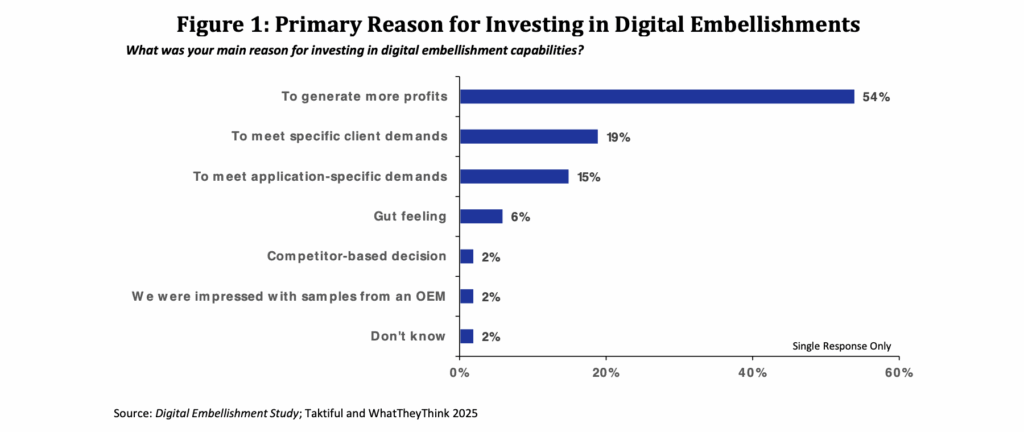
In regard to profitability, this same survey revealed that 35% of respondents thought that digital embellishment jobs were “always” more profitable than regular CMYK jobs. Meanwhile, 44% said that they “usually” are more profitable. A different question showed that roughly two-thirds of respondents (65%) were satisfied with the profits they made off digital embellishment jobs, but only 37% were satisfied with the sales levels of these jobs.
The level of client interest in digital embellishments was quite high. In fact, 88% of respondents said that their clients were at least somewhat interested in digital embellishment capabilities. Keep in mind that this is not a reflection of overall market interest; these survey respondents are actively marketing their own digital embellishment services to their clients.

When asked about the future of print embellishments, the responses were quite promising. 36% of respondents felt very positive about the future of print embellishments, and another 52% felt positive. Only 6% of respondents reported negative feelings.
Is the Market Evolving?
A few years back, Keypoint Intelligence conducted a digital printing trends survey that included a question about the general level of interest in print enhancement (also known as digital embellishment) capabilities. At that time, it was clear that some PSPs were having trouble marketing and selling CMYK+ print enhancements to their customers. According to survey respondents in the United States, 14% of digital print jobs included a print enhancement of some kind and 16% of color digital print jobs had some kind of enhancement. Looking more deeply into the numbers, it became clear that only a relatively small number of PSPs were doing a lot of print enhanced jobs; most were not. Respondents also reported that they could upcharge an average of 23% for print-enhanced jobs. The most popular applications were business cards, brochures, mailers, book covers, and marketing/promotional documents.
When respondents were asked about their challenges with CMYK+ print enhancements, the most common included lack of market/customer demand, challenges associated with upselling customers from CMYK, and selling the value to customers and prospects. Respondents were less concerned about the cost of CMYK+ equipment or consumables, or the time or difficulty required to produce artwork for CMYK+ jobs.
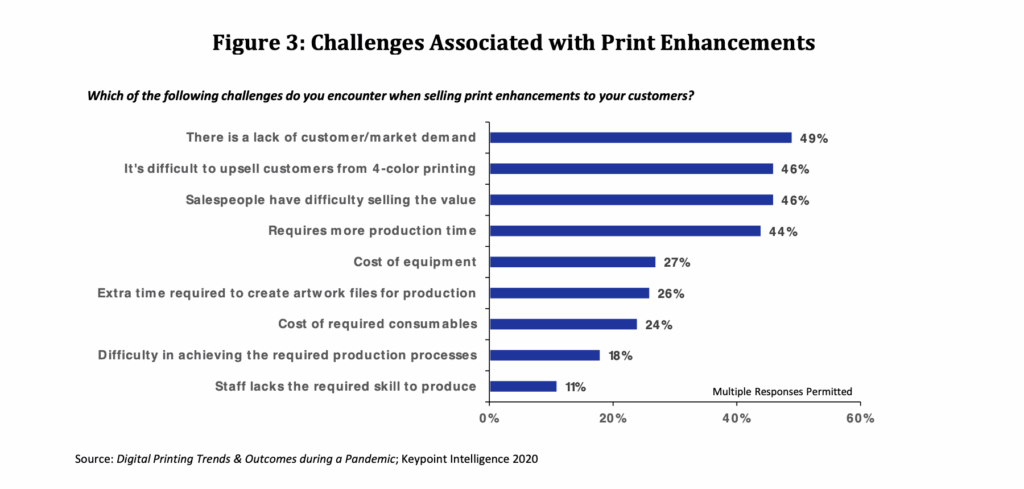
A follow-up question about deterrents to CMYK+ again cited lack of market/customer demand. An astounding 58% of respondents cited this reason, and it came in well above any other factor. Despite this rather gloomy outlook, respondents were still somewhat optimistic about growth in the demand for CMYK+ print enhancements. On average, respondents expected to see a 3.7% increase in demand over the next five years.
Conclusion
In comparing the results of these studies, one wonders if efforts to promote digital embellishments are succeeding over time. It is important to consider, however, that the Taktiful/WhatTheyThink 2025 study reflects the responses of only about 50 North American PSPs with digital embellishment capabilities. This is a good starting point given the stage of the market, but more respondents would be even better.
Author bio: Jim Hamilton of Green Harbor Publications (www.greenharbor.com) is an industry analyst, market researcher, writer, and public speaker. For many years he was Group Director in charge of Keypoint Intelligence’s (formerly InfoTrends’) Production Digital Printing & Publishing consulting services. He has a BA in German from Amherst College and a Master’s in Printing Technology from the Rochester Institute of Technology.